

UCS doubles food impact with Mother Cabrini grant
United Community Schools fed twice as many families in New York City and Albany during the 2024-25 school year as…
United Community Schools fed twice as many families in New York City and Albany during the 2024-25 school year as they had in the previous school year, as mentioned in Crain’s New York Business.
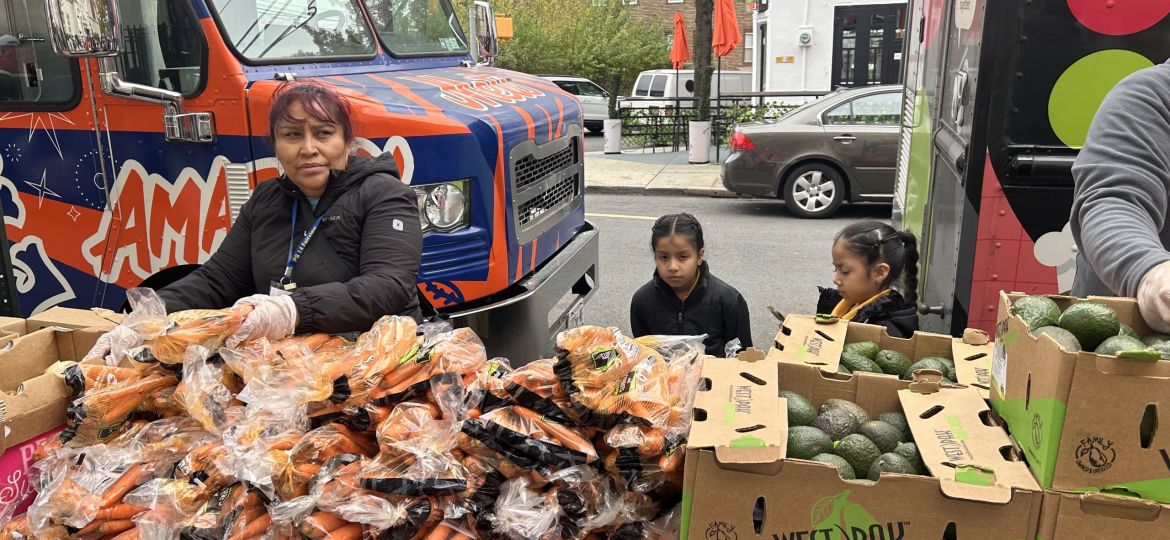
How? Through a $325,000 grant from the Mother Cabrini Health Foundation (MCHF) which was renewed for the 2025-26 school year. UCS schools used this funding to create or expand onsite food pantries which distribute fresh produce, dairy, meat and culturally relevant foods to students and their families.
Thanks to the MCHF, Community School Director Sheba Giraldovallejo increased the frequency of food pantries at her school, PS 19 in Corona, Queens, from monthly to weekly.
Some grants only pay for nonperishable foods, like canned goods. But this grant can be used to purchase a broad range of foods along with equipment such as refrigerators and shelving. “I’m able to buy tortillas,” Giraldovallejo said, remarking on the flexibility of the MCHF’s funding. “I’m able to buy whole milk.”
Flexible funding from the MCHF also helps UCS schools to meet the needs of unhoused students. Allison Brown, the community school director of PS 14, also in Corona, recalled using the grant to buy instant ramen, oatmeal and other microwavable foods for a family living in a Manhattan hotel room with no kitchen. A local pharmacy donated a “granny cart” so the family could get their groceries from Queens to Manhattan more easily. In this and other ways, the UCS model used local resources to stretch the MCHF’s funding even further.
In a September 2025 survey of families in New York City and Albany who used UCS food pantries, 77% said they spent less money on food thanks to the pantries. About a quarter of students at both schools live in temporary housing, so every dollar saved is a dollar available for the creation of a more stable future.
“Before the Mother Cabrini grant, we served about 35 families per week,” said Brown. “That has gone up to 125 families per week.”
Brown describes the food pantry as a “gateway to parent relationships” between the school and its families because “parents see that the school cares enough to help them in a concrete and tangible way.” This builds trust, which leads to greater parent involvement.
She recalled a family with a chronically absent 2nd-grader whose attendance improved after a series of check-ins during the family’s weekly visits to PS 14’s food pantry. The school used these informal conversations to co-create an attendance plan with the family.
For some parents, receiving food from their school sparks a deeper interest in community care and leadership. Some pick up shifts at their school’s food pantry, and, according to Brown, all the board members of PS 14’s parent association started out as food pantry volunteers.
“It’s an opportunity to get involved in the school community,” said Brown. “Parents are not just receiving food – they’re also giving back.”
Francesca Reyes is a PS 14 parent and volunteer who enjoys serving her neighbors and having easy access to free, fresh produce. She shared a story about sneaking kale and mushrooms from the food pantry into her picky husband’s dinner. “If we don’t eat healthy, our children aren’t going to eat healthy,” she said with a laugh.
In a survey of families who used UCS food pantries, 88% credited the food pantries with their families eating more fruits and vegetables. Reyes pointed out that “the better a student eats, the better their body and mind will develop.”
Reyes is “impressed” by what the UCS model has done for her school. “Community schools are about connection and help and hope,” she said. “They identify needs and supply solutions.” Identifying herself with her school, she added, “We’re here for you so that your children can have a better learning environment.”